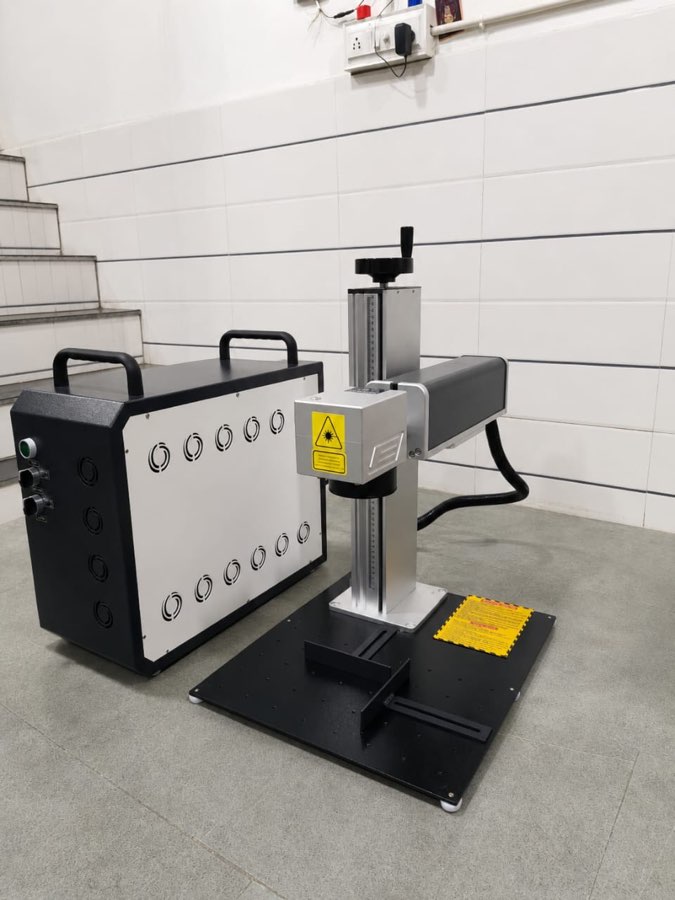
Standalone machine or SPM: where the line is drawn
With a standalone laser marking machine, an operator places the part, lines it up and presses start. That is the right buy for mixed jobs, short batches and shops where the part changes every hour. An SPM makes sense when the job stops being mixed:
- The same part arrives in volume and every minute of handling adds up across a shift.
- The line sets the cycle time, so loading, marking and unloading have to fit inside it.
- The position is fixed by the drawing. Automotive drawings usually fix where the code goes, and a fixture puts it there every time.
- Several faces need a mark, or the part has to be turned or indexed between marks.
- Every code must be checked and logged before the part moves to the next station.
- Operator mistakes must be designed out, such as running the wrong program for the part that is loaded.
What goes into a laser marking SPM
A typical laser marking station combines some or all of the following. Which ones your station needs depends on the part and on how it reaches the marker.
- Laser source. A fiber laser for most metal parts, a MOPA laser for black marks on anodised aluminium, a UV laser for plastic connectors and housings, and a CO₂ laser for rubber and packaging.
- Part fixture. A nest that locates the part on its datum faces, ideally so it can only be loaded one way, with sensors that confirm the part is present and seated.
- Enclosure and guarding. A closed marking chamber with door interlocks keeps the laser contained on the shop floor, with fume extraction at the mark.
- Motion, where needed. A Z axis to keep focus across part variants, or an indexing table or rotary axis for round parts and marks on more than one face.
- Controls and line signals. Start buttons for a manual station, or a PLC handshake (ready, start, done, fault) when the station is part of a line, with recipe selection by part number or barcode.
- Data and verification. Serial numbers and part data from the PLC, a database or a file, and a reader that grades each Data Matrix code and rejects parts that fail.
Laser marking SPM for automotive components
Much of NMB's SPM work has been for automotive component makers. Across the industry, the parts that end up in a marking station are much the same: engine and transmission parts, gears and shafts, brake and steering components, castings, motors, plastic connectors and housings, and nameplates. The mark usually carries a part number, supplier code, date and shift code, a serial number and a 2D Data Matrix code that links the part to its production record.
Related application guides: engine parts, gears, brake pads, chassis, hydraulic and pneumatic components, wiper motors, window motors and connectors.
Data Matrix traceability and code grading
Vehicle makers and tier 1 customers often specify the code size, the quiet zone around it and a minimum print grade for direct part marks, commonly assessed to ISO/IEC TR 29158 (AIM DPM). A station with a verifying reader grades each code as it is made, so a weak mark is caught at the station rather than at the customer's goods inward.
Marking before or after machining, heat treatment or coating
Where the mark goes in the process changes the station. Marking after the last finishing step gives the sharpest code. Marking before heat treatment, shot blasting or plating means the code has to be deeper to survive, which takes more laser time per part and affects the cycle time the station can hold.
How an SPM project runs with NMB
- Part and requirement. Send drawings or sample parts, the mark content, your customer's marking specification, the cycle time, how the part arrives (by hand, conveyor or robot) and where the data comes from.
- Marking trial. Your parts are marked at the Poonamallee demo centre to confirm the laser type, power and time per mark.
- Station concept and quote. NMB proposes the fixture, guarding, motion and controls, and quotes for the complete station with GST shown separately.
- Build and trial. The station is built to the agreed concept and tried on your parts.
- Installation and training. The NMB team installs the station at your plant, connects it to your line signals and trains operators and maintenance staff.
SPM or online laser marking machine?
An online laser marking machine is mounted over a conveyor you already have and marks parts or packs as they pass. An SPM is the whole station. If there is no conveyor, or the part must be located precisely, turned, or marked on several faces, the SPM is usually the better fit. Where a mark must be an indentation that survives paint, a dot pin marker may still be the right tool; see laser vs dot pin.
Laser marking SPM supplier in Chennai, for plants across India
NMB Enterprises works from one location, the office and demo tech centre at Poonamallee, Chennai, close to the automotive plants of Sriperumbudur, Oragadam and Irungattukottai. NMB supplies and installs marking systems across India, including Hosur, Bangalore, Coimbatore and Hyderabad. SPMs are quoted per project; standalone fiber laser marking machines start at ₹2,00,000 + GST. Call or WhatsApp 098417 60722 with the part and the mark you need.